 By John Green, Trustee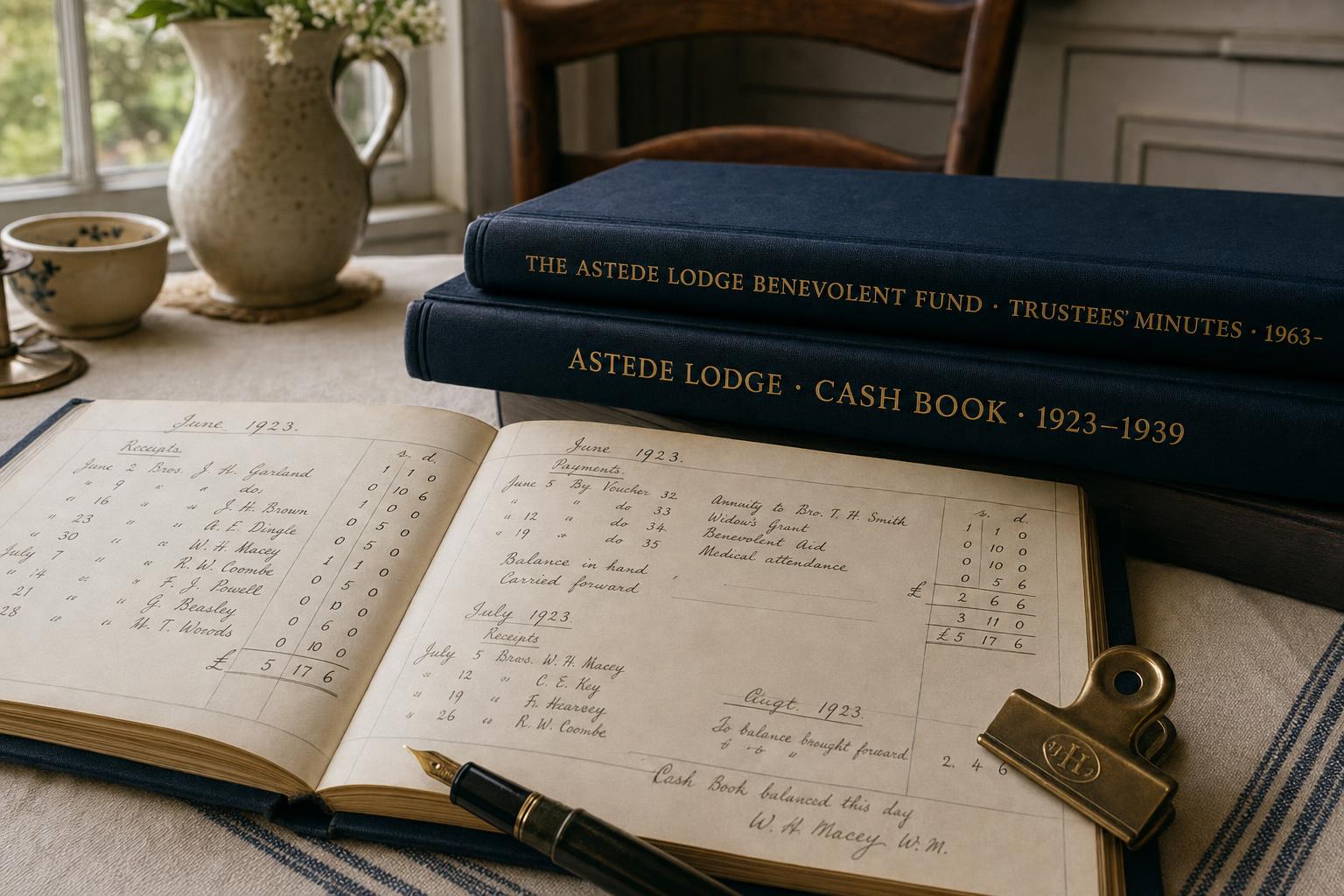
The Trust was registered on the fourth of February 1963, but the act of small-scale giving that the Trust was set up to formalise had been going on, in this Lodge and in this corner of Surrey, for at least four decades before that. The Lodge minute books — which the present Lodge Secretary has been kind enough to lend me for the writing of this piece — record sums going out of the Lodge cash-box, under various small headings, from the early 1920s onwards. They are inscribed in copperplate hand, in pen and ink, in a series of three navy-cloth-bound ledgers now kept in a steel cabinet in the Lodge room. I have spent perhaps fifteen hours with them this autumn. They are unromantic, repetitive, and oddly moving.
The cash-book, 1923
The earliest entry I have found is dated 14 February 1923. The handwriting is that of the then-Treasurer, a Brother Rowland Banks of Leatherhead, and reads simply: "To Brother Hughes's widow — £1 0s 6d — agreed." Hughes had died the previous December; his widow lived in Ashtead. The sum — about £75 in today's money — was paid, the Lodge minute makes clear, in cash and in person, by the Almoner of the day.
The pattern of these early entries is consistent. They appear sporadically — perhaps three or four a year between 1923 and 1939 — and they are nearly always for round sums between ten shillings and three pounds. They are always for individuals known personally to the Lodge: a widow, an injured Brother, occasionally a Brother's daughter setting out into nursing training. The entries do not give reasons, only names; the reasons were known to everyone present at the meeting.
I have counted forty-two entries of this kind between 1923 and the outbreak of the Second War. They total approximately £42, which in today's money is something between £2,500 and £3,000. A small fund, even adjusted for inflation; but a faithful one.
The war years
The cash-book for 1940 to 1945 is the most heavily annotated of the three. The entries are smaller — wartime austerity reduced the Lodge's outgoings considerably — but they are more frequent. I count fifteen small grants in 1942 alone, the largest only fifteen shillings. The recipients are no longer only Brethren's widows; the entries now include a "fund for Brother Allen's son's bicycle, lost in the raid on the high street, Leatherhead" (March 1944) and "contribution to billeting expenses, Mrs Holloway, after the loss of her home in the second raid" (November 1944). The Lodge was, in those years, the closest thing to a community-emergency fund that this small slice of the Mole Valley had.
One entry stops me whenever I come to it. In May 1941, the Lodge paid out fifteen shillings for "a small wreath for Brother Hooper's son, killed in the convoy". The boy had been twenty-one. The wreath was carried to the funeral by the Almoner of the day. The Lodge then voted, at its next regular meeting, to send fifteen shillings to the boy's mother on the anniversary of his death "until such time as it ceases to be needful". The anniversary payment continued for thirty-eight years, until Mrs Hooper's own death in 1979. I have checked the entries; we paid it every May without fail.
"The anniversary payment to Mrs Hooper continued for thirty-eight years, every May, until her own death in 1979. The Trust took the payment on as one of its first acts when it was registered in 1963."— from the Trustees' history papers, December 2025
The post-war decades, and the moment of registration
Between 1946 and 1962 the small grants continue at much the same rate — perhaps five or six a year, mostly to widows and elderly Brethren. The sums creep up gradually with inflation: by 1955 the average payment is two pounds; by 1962, three pounds and ten shillings. The cash-book is now in the hand of a third Treasurer, Brother Cleveland of Bookham. His writing is brisker than Rowland Banks's, and he sometimes notes the reason: "coal — Mrs Whitlock"; "clothes for child — Bro. Tomlin"; "Christmas — eleven envelopes".
The decision to register the fund as a charitable trust came in the autumn of 1962. The Secretary's notes from the October Lodge meeting are very plain: a Brother's widow had been found in difficulty over a coal bill; the cash-box had been raided for fifteen shillings; the Secretary had observed, drily, that "a fund kept by gentlemen's agreement is no fund at all when the gentleman dies on a Tuesday in February." A small committee of three — the Master, the Secretary, and the then-Almoner — was appointed to draw up a trust deed. They did so in three weeks, lodged it with the Charity Commission in early January, and received the registration certificate, numbered 218915, on the fourth of February 1963.
What has changed, and what has not
Sixty-three years on, the fund's annual outgoings are very nearly identical in shape — though smaller in real terms — to what they were in 1925, in 1950, in 1972. Most of the money still goes out as small envelopes to widows of former Brethren, with the occasional larger sum for an immediate need. The Christmas envelope evening, started in 1969, is the lineal descendant of the November and December entries that appear in every cash-book since 1923. The small annual cheque to a local foodbank, started in 2010, is the modern descendant of the early-1920s entries marked simply "to Mrs Goodfellow, foodstuffs".
What has changed — gradually, over the century — is the geography. In the 1920s the Lodge sent small sums as far as Mickleham, Box Hill and Effingham; today we are bound by the trust deed to four parishes. The Trustees of 1963 made a deliberate choice to draw the boundary tighter, on the grounds that a small fund can only really know one small place. I think they were right.
Why it matters to write this down
I am writing this piece because I think a fund of this kind ought to keep an account of itself in language as well as in numbers. The Annual Returns are very plain — a single line of receipts, a single line of payments. They do not tell anyone about Mrs Hooper, or about the wreath, or about the fact that the Lodge has been quietly doing a piece of this work for a century without ever quite admitting that it was doing it.
If you are reading this, and you are minded to give a small sum to keep the next decade going, you will find the link to do so a few paragraphs below. But even if you are not — even if you are only here out of curiosity — I am glad you have read this far. A small fund is mostly invisible work, and it is occasionally good to look at the ledger.
With grateful thanks to the Lodge Secretary, Arthur Penny, for the loan of the cash-books. To support the fund's next decade, please make a small gift. Reg. Charity 218915.