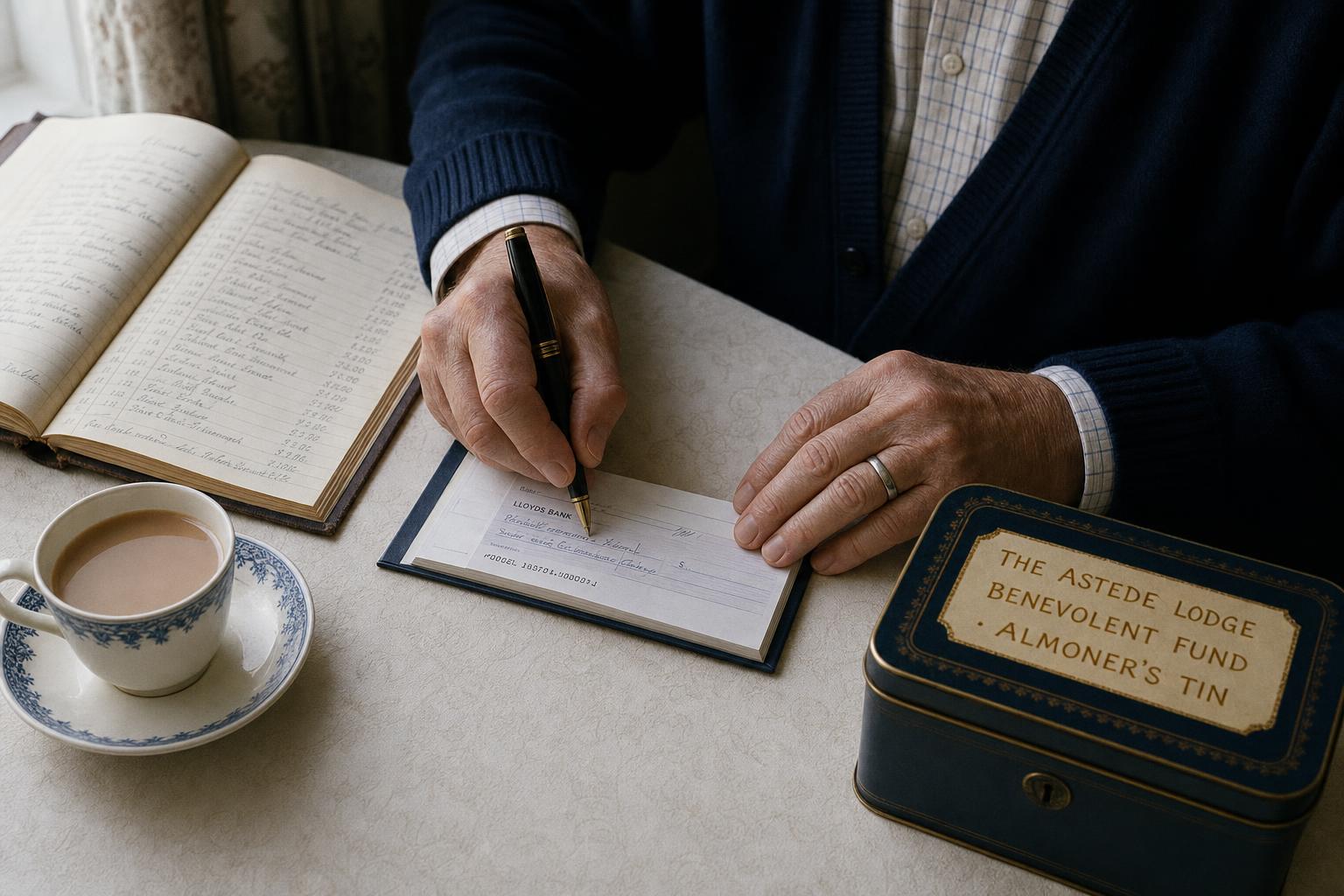
Our purposes are unchanged since 1963. They are written into the trust deed in language that now reads as a little formal, and they say two things: that we exist to relieve need amongst the members of Astede Lodge and their dependants, and that we exist to support charities — Masonic and otherwise — operating principally in the parishes of Fetcham, Ashtead, Bookham and Leatherhead. Sixty-three years on, that is still what we do.
What has changed is the language around the work. The trust deed talks of 'distressed Brethren'; we talk now of Brothers and their families going through a stretch of difficulty. The deed speaks of 'sundry charitable purposes within the parishes'; we talk now of a foodbank in Leatherhead, a parish hall heating fund in Ashtead, a community garden in Fetcham. The work has stayed the same shape; we simply describe it differently.
Theory of change, in three honest steps
We are not a research-driven organisation and we do not pretend to a complicated theory. The Trustees have written, however, what we believe to be the three-step path by which a pound put into the fund becomes a piece of relief — so that anyone giving knows what their gift is for. It is set out below.
Step 01 · Listen
A confidential conversation
A Brother, a widow, or a partner charity raises a quiet need with the Lodge Almoner. The first thing that happens is a private conversation, usually around a kitchen table, often over tea.
Step 02 · Decide
Two Trustees, one small decision
The Almoner brings the request to both Trustees. They consider it together, weigh it against the trust deed and the year's remaining reserve, and either approve, decline or refer the request to a larger source.
Step 03 · Hand it on
A cheque, a note, a postage stamp
A handwritten cheque, a short letter signed by both Trustees, and a first-class stamp. The whole apparatus, from first conversation to envelope through the letterbox, usually takes between five and ten working days.
Our values, in five short clauses
- Confidentiality first. Names of beneficiaries are not recorded outside the Trustees' minute book; the public reports speak in totals only.
- Small and fast. A small fund's only real advantage is speed. We aim to make a decision within a working week and to send a cheque within ten days.
- Local, by deliberate choice. We will not fund work outside the four parishes — Fetcham, Ashtead, Bookham, Leatherhead — even if the cause is excellent.
- Plain accounts, plain prose. Our annual return is a single page. Our dispatches are a single sheet. We believe in writing as we speak, and in keeping the books in a way two retired Brethren can audit.
- Two-to-a-cheque. Every payment is signed by both Trustees. Every refusal is recorded in writing, with a reason.
An honest limitation, written plainly
It would be dishonest to write this page without also writing the next paragraph. We are not always quick enough; we have, twice in the last decade, taken longer than the ten working days we hold ourselves to. In one case — in early 2019 — a request for help with a winter electricity bill arrived during a stretch when both Trustees were unwell, and the cheque went out three weeks late. The family in question were kind about it; we were less kind to ourselves. We have since agreed that if both Trustees are unable to meet within the week, the Lodge Almoner has standing authority to draw an emergency advance of up to £50 from the petty-cash box, repayable on the Trustees' next sitting. That arrangement is the most useful thing we have changed in twenty years, and it came out of a failure rather than a plan.
We also do not — and will not — fund work outside the four parishes. Brethren who have moved away sometimes write asking for help with bills in towns we do not know. We always reply, but we always decline; the trust deed binds us to a small geography, and we believe it is right to keep it small.
"A small fund's only real advantage is speed. If we cannot answer within a working week, we are no use at all."— Minute of the Trustees, May 2019
How we measure ourselves
We do not use the language of impact, output, or outcome. We do count three things: the number of confidential approaches to the Almoner in a year (between 12 and 22 for the last decade); the percentage we are able to act on (consistently between 70 and 90 per cent); and the average elapsed days between first conversation and posted cheque (six, in 2024). These three numbers are reported in the annual report each spring.
We will know we have done well if, twenty years from now, a Brother's widow in a cottage in Fetcham still receives a Christmas envelope from the Trustees of the day, signed by hand, written in plain English, and bearing — in its small way — the warmth of a fund that has not forgotten her.